Between Skill and Imagination:
What AI Is Doing to Creativity, and to Us
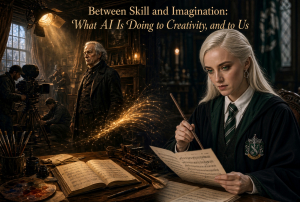
Scroll any video feed for ten minutes and you will hit it. A Harry Potter scene reimagined as a 1980s sitcom. Draco Malfoy rewritten as Draconia, a sharp, pretentious young woman locked in a slow-burn romance with Harry. A song that sounds like it was cut in Nashville in 1974, except nobody in Nashville had anything to do with it. Some of it is clumsy, with six-fingered hands and voices that drift off key in strange ways. Some of it is oddly good. Most of it gets lumped under one dismissive label: AI slop.
I understand the label. I also think it hides more than it explains.
We are standing at an odd point in the history of making things. For most of human history, the distance between having an idea and showing it to the world was measured in skill, money, and permission. Now a lot of that distance has collapsed. That leaves a question nobody has a clean answer to: if imagination no longer needs craft to be seen, what happens to craft, and what happens to the people who never build it?
The case against: what we stand to lose
Look at what goes into a serious film. Ti West’s Ebenezer, the new take on A Christmas Carol with Johnny Depp as Scrooge, is a good example of the old way at full strength. You have a director with a specific, hard-won sense of atmosphere. You have actors like Depp, Andrea Riseborough, Daisy Ridley and Rupert Grint. These are people who have spent decades learning how a glance or a pause lands on camera. Behind them are writers, cinematographers, set designers, costume shops, sound crews, editors, colorists, and a production system that has to run on time and on budget for any of it to work.
None of those people woke up good at their jobs. A sound mixer learns by ruining mixes. A cinematographer learns by shooting badly lit scenes and figuring out why they look wrong. That learning is slow and expensive. It is where mastery comes from.
When a film like this comes together, you are watching thousands of hours of failure that turned into judgment.
AI tools let you skip that path. Type a sentence, get a cinematic shot. Describe a mood, get a finished track. The output can look and sound like the product of mastery without any of the mastery behind it. That is the real worry, and it is bigger than lost jobs, although lost jobs matter. The worry is that the next generation of sound mixers and cinematographers never shows up, because nobody had a reason to learn the hard way.
The case for: who finally gets a voice
Now flip it around.
For a century, getting creative work in front of a large audience meant getting through gatekeepers. Film studios. Record labels. Publishers. Networks. They controlled the cameras, the studios, the distribution, and the promotion budgets. If you had a story in your head but no money, no connections, and no crew, the story usually stayed in your head.
That system did not filter only for talent. It filtered for access, for geography, for who you knew, for what a marketing department thought would sell that quarter. Plenty of brilliant people never got through, and plenty of mediocre work did.
AI tools hand some of that missing machinery to individuals. Editing, image creation, sound design, music production, even the rough edges of promotion: these used to require a team. Now one person with a clear idea can get something real out into the world. That is not nothing. For a lot of people it is the first time their imagination has had a way out.
And if you look closely, a lot of so-called slop is not lazy. Some AI videos come from a one-line prompt and it shows. Others come from people who wrote full scripts, storyboarded shots, ran hundreds of generations, and edited the results by hand. Some AI songs are a single sentence typed into a box. Others start with lyrics someone sweated over for weeks and a style built up through dozens of revisions. Most land somewhere in between. Dismissing all of it as one thing is as lazy as the laziest prompt.
The Malfoid effect: when the audience holds the pen
One trend shows where this is going better than any other. Fans call it “Malfoid”: Draco Malfoy reimagined as a girl, Draconia Malfoy, a strong, proud, more than a little pretentious young woman.
It is worth noting where this started. Malfoid took off in September 2026 as hand-drawn fan art from human artists, and those posts pulled in millions of views within weeks. By late October the trend had gone so mainstream that the U.S. Department of Education’s official account posted its own Malfoid image, which drew roughly 4.8 million views.
The AI videos built on what those illustrators set in motion. A creator who goes by Foyege, through a series called In Another Universe, used AI to turn the idea into a story. The schoolyard rivalry becomes an enemies-to-lovers romance with Harry, who stays the strong lead he always was. The faces are a bit uncanny in places, but the editing, camera movement and music are better than a lot of people expect. Human skill lit the spark, and AI turned it into a running story. That is the hybrid I keep coming back to.
(The name “Malfoid” has an awkward online origin, since it borrows an incel slang term, and some people question it. In practice, many people treat it as a playful nickname for this one character.)
There are critics. Some find the whole thing strange. Some think it disrespects the original. Some object to how a few people have sexualized the character, and some cannot get past the name. But from what I have seen, the reaction has been far more positive than negative or undecided. Most people are simply enjoying it, sharing it, and asking for the next episode.
Whether you love Draconia or not, the bigger point is one most people have not caught on to yet.
HBO’s Harry Potter series is due in 2027, with Dominic McLaughlin as Harry and Lox Pratt as Draco. It is a huge production, built by exactly the kind of skilled crews and systems I described above. And when it arrives, it lands in a world where the audience no longer has to accept the version it is given. Don’t like how a scene was cast? Think a storyline was cut or rushed? Wish a side character got more time, or a romance went another way? Fans will be able to “fix” it themselves, with AI, and put their version out within days.
Fan fiction is not new. People have rewritten stories they love for as long as stories have existed. What is new is the medium. A fan rewrite used to be text on a forum, clearly separate from the official work. Now it can look and sound like the show itself. For the first time, the audience can answer a studio in the studio’s own language.
That cuts both ways. It is the democratization argument in its purest form: nobody needs permission to tell their version. But it also raises hard questions. What happens to the authority of the original when a hundred polished alternatives sit one click away? What will the show’s actors think when their own faces and voices are reshaped into stories they never agreed to? And if every viewer can bend a story toward exactly what they wanted, do we lose the experience of being challenged by a story that did not give us what we wanted?
Human slop is still slop
Here is the part the debate tends to skip: humans have always made slop too.
We have all sat through movies that should never have been greenlit. Scripts that fall apart in the second act. Directors who had no idea what they were doing. Actors cast for their name rather than their fit for the role. Sequels made purely because the first one made money. Shows padded out for an extra season. Songs written by committee to hit a playlist algorithm. None of that needed a neural network.
So the line between “real art” and “slop” was never about the tools. It has always been about care, vision, and effort. A human-made film with no vision is slop. An AI-assisted short with a real idea and real craft in the editing might not be.
When you put the two sides next to each other, they share more than either camp wants to admit. Both have masterpieces and garbage. Both depend on someone with an idea deciding it is worth making. The difference is how much skill the tools demand of the person holding them.
The Custodian problem
That difference is where I think the danger lives.
There is an early episode of Star Trek: The Next Generation called “When the Bough Breaks” (Season 1, Episode 17). The Enterprise finds Aldea, a planet everyone thought was a legend. The Aldeans live in comfort under a cloaking shield. Their whole society has turned itself over to art and leisure. A central computer called the Custodian runs everything for them: power, defense, maintenance, all of it.
The catch is that the Aldeans no longer understand the Custodian. Generations of letting it handle everything left them unable to operate it, fix it, or even really grasp how it works. When their people become sterile, they cannot figure out why. They end up kidnapping children from the Enterprise, Wesley Crusher among them, to keep their civilization going.
It takes an outsider, Dr. Beverly Crusher, to work out the cause. The shield that protects them has thinned their ozone layer. The radiation coming through is what is making them sick. The thing keeping them safe is the thing slowly poisoning them, and they never knew.
I keep coming back to that image: a society of artists that forgot how its own world works.
That is the risk with AI and creativity. Not that machines will replace art, but that we hand over so much of the underlying skill that we lose the ability to understand, question, or repair what we are making.
If nobody learns to light a scene, mix a vocal, write a chord progression, or structure a story, then we are entirely dependent on the tool. We can no longer tell when it is wrong. We can no longer push past what it was trained to do. And we lose the kind of risky, hands-on experimentation that has always pushed human art into new places, because nobody pushes a medium they do not understand.
The Aldeans had beautiful art. They had no idea how to keep themselves alive.
Why we need both
So where does that leave us? I do not think the answer is picking a side.
We should welcome the democratization. People with ideas deserve a way to express them without needing a studio’s blessing or a label’s budget. Breaking up the gatekeepers’ monopoly on access is a good thing, and AI tools are part of how that is happening. A world where more people can make things is a richer world.
But we also have to keep growing, protecting, and rewarding real skill. That means valuing the craftspeople who make films like Ebenezer possible. It means teaching the fundamentals of music, film, writing, and design even when a shortcut exists. It means celebrating people who take creative risks, the ones who fail in public and try again, because that is how a medium moves forward. And it means individual creators using AI as a place to start, not as a reason to stop learning.
If you want to see what is worth protecting, look up Tim from Kicking Harold. Tim David Kelly is a working musician who founded the alternative rock band Kicking Harold in the 1990s. The band’s song “Gasoline” became the theme for TLC’s Overhaulin’, and he has written and produced for television and other artists for decades. Since 2022 he has posted thousands of short videos on Instagram as “timfromkickingharold,” walking through the stories behind rock songs and the people who wrote them. He has built an audience of close to a million followers doing it.
What comes through in those videos is how closely songwriting is tied to real life. A song comes out of a bad breakup, a fight in the band, a lucky accident in the studio, a riff someone almost threw away, a deadline, a city, a specific night. The craft is there, but so is the life behind it. That link between what someone lived and what they made is a big part of why a song lands. An AI model can copy the sound of that history. It cannot live it. If we go fully hands-off and let the tool do all the work, that is the part we lose first, and we may not notice it is gone until the songs stop meaning anything.
The healthiest version of this future looks like a person who uses AI to get an idea off the ground and then gets curious about how the thing actually works. Someone who generates a song and then wants to learn why that chord change hits so hard. Someone who makes an AI short film and then picks up a real camera to see what they can do with their own hands. Imagination opens the door. Skill is what lets you walk through it with your eyes open.
If we get this balance right, we get more voices and better craft at once. If we get it wrong, we end up like Aldea: surrounded by beautiful things, with no idea how any of them work.
A personal note
In the interest of full disclosure: I use Suno. I write my own lyrics, and I spend real time shaping the style and sound of each piece. I enjoy it a great deal. It is not a business for me, and I have no plans to make money from it. It is a hobby that keeps my mind active, gives me a reason to play with words and rhythm, and lets me hear ideas that would otherwise stay stuck in a notebook.
I mention it because I do not think this question is abstract. I feel both sides of it every time I sit down to make something. The tool gives me a voice I would not otherwise have. The lyrics are the part I am proudest of, because they are the part that came from me. And I want to keep it that way.
That is the balance I am arguing for. Use the tools. Keep the skills. Do not forget how to be human.
By AJ –
The image is obviously AI, I have no such skills


