The Price of Being Seen
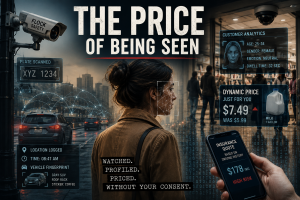
AI surveillance networks and algorithmic pricing are converging into a commercial infrastructure that watches you, profiles you, and charges you accordingly. Usually without your knowledge. Always without your consent.
The Network You Never Agreed to Join
On any given commute, your license plate is scanned multiple times before you reach your destination. Not by police cruisers, but by a distributed mesh of fixed and mobile cameras operated by companies like Flock Safety, Motorola’s Vigilant Solutions (its LEARN platform), and a range of smaller regional vendors. By the time you pull into a grocery store parking lot, several different systems may have logged your arrival, cross-referenced your registration, and shared your vehicle’s passage with subscribing law enforcement agencies, homeowners associations, and private security firms.
Flock Safety’s own 2025 Impact Census, drawing on nearly 700 law enforcement agencies across 43 states, reports the company supported approximately one million cases that year. As of mid-2026, the network spans roughly 120,000 cameras across more than 6,000 municipalities in 49 states, performing over 20 billion vehicle scans per month. What the company’s marketing does not foreground is that for every genuine criminal it helps identify, it catalogs the movements of millions of ordinary people who have done nothing wrong. The system doesn’t just read your plate. It records your vehicle’s make, model, color, and distinguishing features, such as a cracked bumper, a distinctive sticker, or a roof rack, building what the company calls a “vehicle fingerprint” that persists regardless of whether the plate itself is registered.
This is the infrastructure of ambient surveillance. It does not announce itself. It does not ask permission. It simply watches, stores, and waits.
“Transforming an exceptionally dangerous mass surveillance system into one that is fully protective of civil rights and civil liberties is a difficult, if not impossible task.”
— Chad Marlow, ACLU Senior Policy Counsel
Beyond license plates, a new generation of AI-powered retail cameras is being sold to major chains on the premise of “customer analytics.” Companies including Quividi, RetailNext, and Sensormatic market systems capable of identifying a shopper’s approximate age, gender presentation, emotional affect, and dwell time in front of a given display. The cameras don’t need to know your name. They need only to see your face often enough to recognize the pattern of it.
The privacy problem with this network is not simply that it exists. It is that the data flows between its nodes with very little friction, very little oversight, and almost no transparency to the people being recorded.
What the Court Said, and the Gaps It Left Open
In June 2026, the Supreme Court delivered what privacy advocates called the most consequential Fourth Amendment ruling in a decade. In Chatrie v. United States, decided 6 to 3, the Court held that law enforcement’s use of “geofence warrants” constitutes a search under the Fourth Amendment. These warrants are demands served on companies like Google to produce the location records of every device present within a given geographic boundary during a specified time window.
Writing for the majority, Justice Elena Kagan rejected the government’s argument that location data stored briefly with a third-party tech company falls outside constitutional protection. “The breadth and granularity of this data,” Kagan wrote, “goes far beyond anything the drafters of the Fourth Amendment could have conceived as legitimately subject to warrantless government access. A person’s entire pattern of movement does not lose its constitutional character simply because a corporation retained it.”
Chatrie v. United States, June 2026, 6 to 3: The majority held that geofence warrants constitute a Fourth Amendment search, requiring the government to demonstrate constitutional reasonableness before sweeping up mass location data from innocent bystanders near a crime scene. The ruling directly limits police authority to conduct dragnet digital surveillance. Justices Thomas, Alito, and Gorsuch dissented.
The ruling is real progress. It is also, in the context of private surveillance infrastructure, insufficient.
Chatrie constrains the government. It does not constrain Flock Safety. It does not constrain the AI camera mounted above the entrance to your neighborhood pharmacy. It does not prevent a data broker from aggregating license plate records captured by private systems and selling the result to insurance companies, employers, or law enforcement agencies that would otherwise need a warrant, through shell arrangements that lawyers are already designing.
“An individual has a reasonable expectation of privacy in records about his cell phone’s location… A person’s entire pattern of movement does not lose its constitutional character simply because a corporation retained it.”
— Justice Elena Kagan, majority opinion, Chatrie v. United States (2026)
The constitutional protections that Chatrie extends apply where the government is the actor. Private companies collecting identical data for commercial purposes occupy a different legal space, one that Congress has so far declined to meaningfully regulate at the federal level.
There is a further risk specific to camera networks like Flock’s: scope creep. These systems were sold to municipalities as tools for recovering stolen vehicles and solving violent crimes. Increasingly, they are used to track people behind on child support payments, detect unregistered vehicles, and enforce immigration detainers. The technology doesn’t know what it was designed for. It only knows what it can see.
You Are the Product. The Price Is Personalized.
Dynamic pricing has existed for decades in airlines and hotels, industries where consumers have grudgingly accepted that the seat next to them may have cost half or twice what they paid. What has changed, and remains largely invisible, is the extension of this logic into everyday retail. AI systems now ingest a person’s aggregated behavioral profile and set a price at the moment that person is most likely to pay it.
The digital shelf label, an electronic display that can update a product’s price in seconds, has moved from pilot program to quiet mainstream deployment in grocery chains across Europe and, increasingly, the United States. The hardware is neutral. The software behind it is not. When those labels are connected to customer identification systems, whether loyalty cards, app sign-ins, or the facial recognition camera above the entrance, the price one person sees can differ from the price the person behind them sees.
The data feeding these systems is vast. A major retailer’s AI pricing model may draw from:
- Loyalty program history: purchase patterns, brand sensitivity, price elasticity, family composition inferred from product mix
- Credit and debit card metadata: income range, spending category, merchant category codes, geographic range of activity (often shared without customer knowledge)
- Web browsing and search history: product research, competitor comparison, urgency signals, health concerns, financial stress indicators
- Social media activity: life events, brand affinities, political leanings, relationship status, life stage
- Mobile location history: competitor store visits, neighborhood income level, commute patterns, travel frequency
- Pharmacy purchase data: chronic conditions, mental health treatment, reproductive status, addiction recovery (inferred)
- In-store camera analytics: dwell time, browsing behavior, emotional affect, demographic presentation
Most consumers are aware, in a general way, that companies collect data about them. What they dramatically underestimate is the depth of that data and the sophistication of the inferences drawn from it. A model trained on millions of purchase histories doesn’t just know that you bought ibuprofen. It knows you buy it every twenty-six days, in clusters, alongside heating pads and dark chocolate. It knows what that pattern means. It knows you may not be particularly price-sensitive on those specific days.
The AI doesn’t need your diagnosis. It has your pattern.
The Breadth Consumers Don’t See
Privacy policies are, by design, difficult to parse. A 2008 Carnegie Mellon study by researchers Aleecia McDonald and Lorrie Faith Cranor found that reading every privacy policy a person encounters in a year would require approximately 76 work days. That figure has not improved. No one reads them. Companies know this.
What those policies disclose, in language precise enough to be legal and vague enough to be meaningless to the average reader, is that your data may be shared with “partners,” “affiliates,” and “service providers.” In practice, your grocery store’s loyalty data flows to a data broker, which combines it with your credit card spending data (purchased from a card network), your location history (licensed from a mobile data aggregator), and your social media profile (scraped and sold by yet another intermediary). The result is a record about you more detailed than anything you have ever consciously assembled about yourself.
“It’s a sweet deal for corporations: consumers are both the product being sold and the ones paying the price.”
— Dr. Lindsay Owens, President & CEO, Groundwork Collaborative
This aggregated record, which the industry calls a “consumer graph,” is then licensed to AI pricing systems, credit underwriters, insurance actuaries, employers running background checks, and landlords screening tenants. It is not sold once. It is licensed repeatedly, generating revenue from the same slice of your life across dozens of industries simultaneously.
The ethical concerns here are significant even under the most charitable interpretation of commercial intent. But the ethical question, urgent as it is, is not the only one worth asking. There is a more visceral one: what happens when this data breaks?
When the Database Falls into the Wrong Hands
Consider a scenario that privacy researchers treat not as science fiction but as a matter of statistical probability: a breach of a mid-size retail chain’s AI pricing platform, or of the data broker that supplies it. The exposed dataset contains not just names and credit card numbers, the kind of breach people have grown numb to, but the full consumer graph. The face. The address. The income estimate. The health inference. The daily pattern. The network of family members, inferred from co-purchased items and shared delivery addresses.
Below is a structured look at what a sophisticated malicious actor could do with that dataset. This is presented not to alarm, but because understanding the harm profile is the only honest way to evaluate whether current data practices are acceptable.
Hyper-personalized Spear Phishing
With knowledge of a target’s purchase history, health patterns, family members’ names (inferred from co-purchases), employer (from location data), and financial stress indicators, a malicious actor can craft phishing communications indistinguishable from genuine correspondence. An email referencing your specific prescription, your child’s school district, and your recent job search is not a generic attack. It is a tailored manipulation designed to bypass the skepticism most people have developed toward obvious phishing attempts.
Physical Pattern-of-Life Exploitation
Camera network data and loyalty card timestamps reveal when you leave home, when you return, which gym you visit on which mornings, and which school you pick your children up from on which days. A burglar with access to this data doesn’t need to surveil your house. They have a schedule. A stalker doesn’t need to follow you. They have a map. Law enforcement professionals treat this type of pattern-of-life data as among the most operationally valuable of any intelligence category. Here it exists in a commercial database whose primary protection is profit motive.
Medical and Financial Extortion
Pharmacy purchase data, health app integrations, and purchasing pattern inferences can reveal conditions a person has never disclosed publicly: mental health treatment, addiction recovery, HIV treatment, chronic illness, reproductive health choices. In professional or custody contexts where such conditions could be weaponized, this data has real extortion value. A person does not need to have done anything wrong. They need only to have bought something sensitive from a pharmacy that shared its data.
Synthetic Identity and Deep Fraud
A consumer graph provides not just a person’s data but their behavioral signature, the patterns that authentication systems are trained to recognize as legitimate. Fraudsters with access to this signature can answer security questions, replicate device usage patterns, and time fraudulent activity to match a target’s normal financial rhythms, defeating the behavioral biometrics that financial institutions have invested heavily in deploying.
Large-Scale Demographic Targeting
At a population level, a breached consumer graph enables the targeting of specific demographic groups by income, health status, political inference, or neighborhood, with disinformation, manipulated pricing in secondary markets, or coordinated fraud. The individual harm profile scales to societal harm when the dataset is large enough. The largest retail data platforms are very large indeed.
Data breach notifications, when they come, mention names, email addresses, and encrypted passwords. They do not say: “We held a model of your daily routine, your probable health conditions, and your family network, and someone may now have it.” They do not say this because they are not required to. And because saying it clearly would reveal the scope of what they were collecting in the first place.
A Right Worth Fighting For
Chatrie v. United States is meaningful. The Court was right to apply Fourth Amendment protection to mass location data, and right to reject the argument that brief third-party retention strips data of its constitutional character. But a single ruling about government searches cannot do the work of the comprehensive federal privacy legislation the United States has lacked for thirty years.
The surveillance camera that logs your entry into a store is not a government actor. The algorithm that sets your price based on your inferred income is not a government actor. The data broker that sells your consumer graph to whoever will pay is not a government actor. The Fourth Amendment, as clarified in Chatrie, does not reach any of them.
Meaningful protection would require, at minimum: a federal right to know what data is held about you and by whom; a right to delete; a prohibition on selling sensitive data categories such as health, location, and financial records without explicit, informed, revocable consent; breach notification that describes what was actually held, not just what category of record was exposed; and real limits on the camera networks proliferating in public and private spaces, whose coverage now substantially exceeds what any reasonable person walking through their own neighborhood would expect.
These are not radical demands. They are the floor. The question is whether a significant Supreme Court ruling, a steady drumbeat of high-profile breaches, and growing public awareness of what AI-driven systems actually know about us will finally produce the political will to build it.
You are being watched. You are being priced. The database exists. The only remaining question is who gets to it first.
By: Adam John
Sources: Chatrie v. United States, No. 24-1143 (U.S. June 2026). Flock Safety 2025 Impact Census (published May 2026, updated July 2026). McDonald & Cranor, “The Cost of Reading Privacy Policies,” I/S: A Journal of Law and Policy for the Information Society (2008). Flock camera network figures: Road Signs / independent mapping research, July 2026. Retail analytics companies confirmed via company websites and published reporting. Threat scenarios are hypothetical extrapolations for analytical purposes, not predictions of specific events.


 August 4, 2026